
Human Handoff Rules: When AI Should Stop and Staff Should Step In
Human Handoff Rules: When AI Should Stop and Staff Should Step In
Human Handoff Rules: When AI Should Stop and Staff Should Step In
The value of an AI-assisted booking system is not that it handles everything. It is that it handles the right things, consistently and at scale, so that the team can focus their time on the things that genuinely require a human. A system that tries to automate everything eventually encounters a scenario it was not built for and produces an outcome that damages the client relationship. A system that knows exactly when to stop, and passes the conversation to a person with full context and a warm introduction, is the kind of system that clients find helpful rather than frustrating. Getting the handoff rules right is one of the most important configuration decisions in any appointment business automation setup. This post covers the four categories that should always trigger a handoff, what a seamless handoff looks like from the lead's perspective and how to build the rules into the system so they fire reliably rather than depending on someone to remember.
Why the Handoff Decision Is the Most Important One in the System
Most discussions about AI-assisted booking systems focus on what the AI does. The handoff rules are about what it does not do, and that is the more important question.
A Powerful AI Helper is excellent at consistent, fast, well-structured responses to common enquiry types. It qualifies effectively, it sends booking links at the right moment, it manages reminders reliably and it keeps nurture sequences running without anyone needing to monitor them. These are the scenarios it was built for and it handles them better than a manual process could.
But there are specific categories of interaction where the qualities that make AI-assisted follow-up effective, speed, consistency, lack of emotional variation, become liabilities. A fast, consistent, emotion-neutral response to a complaint is not a good complaint-handling approach. A smoothly automated qualification sequence for a lead who has just shared a deeply personal reason for enquiring is not the right experience for that person. An AI-generated reply to a request that falls outside the configured scope of the system will either produce something irrelevant or something wrong.
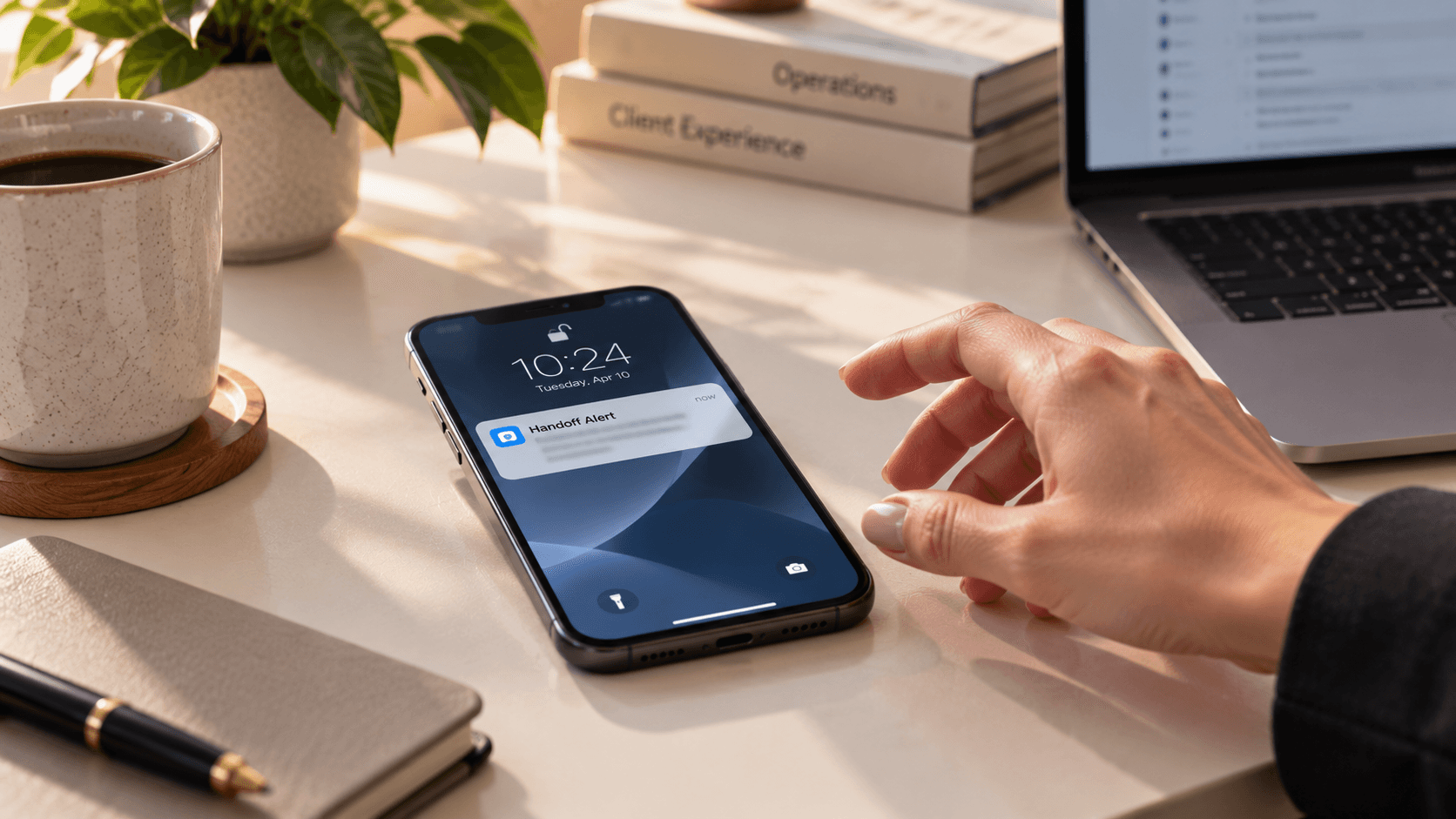
The handoff rules are the mechanism that identifies these scenarios before the automated response causes damage and routes them to the right person with the context they need to handle the situation well.
The handoff rules are the mechanism that identifies these scenarios before the automated response causes damage and routes them to the right person with the context they need to handle the situation well.
Red Flags: Signals That Should Always Trigger a Human Step
Red flag handoffs are the scenarios where continuing with the automated flow creates more risk than pausing and involving a human, regardless of how the automation has been configured.
Expressions of distress or vulnerability
A lead who mentions a health concern, a financial difficulty, a bereavement or any other personal situation that provides context for their enquiry is a person, not just a lead. An automated follow-up that continues the qualification sequence without acknowledging what they have shared is at best tone-deaf and at worst genuinely harmful. Any message that contains emotional content or personal context should trigger an immediate handoff.
Explicit requests to speak with a person
"Can I speak to someone?" or "I would rather talk to a human" should never be met with another automated response. It should be met with a warm acknowledgement and an immediate route to a team member. A system that continues to automate after this request has been made destroys trust faster than almost any other failure.
Messages that suggest the lead is confused or frustrated by the exchange
Signs like "I already answered this" or "this is not what I asked" or "can someone please just call me" indicate that the automated exchange has broken down. These messages need a human response, not a retry of the automated sequence.
Anything that raises a safeguarding or legal consideration
A lead who describes a situation that touches on health and safety, legal or regulatory matters, or any scenario where incorrect guidance from the business could cause harm, must be handled by a person with the appropriate knowledge and judgment.
VIP Leads: Who They Are and Why They Need Different Treatment
Not all leads have the same commercial significance. A VIP lead in the context of an appointment business is one where the potential lifetime value of the relationship is high enough that the investment of personal attention at the first contact stage produces a meaningful return.
The definition of a VIP lead varies by business, but common characteristics include: a referral from an existing high-value client, an enquiry about a premium service category that represents a significant appointment value, a lead who has previously been a client and is returning after a long absence, or a lead whose contact details or stated context indicate a level of commercial significance that the business recognises.
VIP lead identification can be built into the system in several ways. A referral flag added when the lead source is marked as a specific referral. A service type trigger that routes premium service enquiries to a manual review queue after an automated acknowledgement. A returning client flag in the CRM that suppresses the standard automation flow and triggers a personal outreach notification.
The automated acknowledgement for a VIP lead can still be immediate and warm. The difference is that the next step is a personal message from a senior team member rather than the continuation of a standard qualification sequence. The lead feels the benefit of the automated speed without the depersonalisation of an entirely automated journey.
The automated acknowledgement for a VIP lead can still be immediate and warm. The difference is that the next step is a personal message from a senior team member rather than the continuation of a standard qualification sequence. The lead feels the benefit of the automated speed without the depersonalisation of an entirely automated journey.

Complex Requests: Where AI Reaches Its Useful Limit
Complex requests are enquiries that fall outside the standard qualification and booking flow because they require judgment, creativity or detailed knowledge that cannot be reliably programmed into a rule-based system.
For a luxury travel agency, a complex request might be an itinerary inquiry that involves multiple destinations, specific accessibility requirements and a bespoke budget structure that does not map to any standard package. The automated qualification can gather the initial context. The response that addresses the specific complexity of the request requires a specialist.
For a clinic, a complex request might be a multi-treatment inquiry where the appropriate sequence, timing and suitability assessment involves clinical judgment about a combination of treatments rather than a straightforward single-service booking.
For a prestige auto business, a complex request might involve a vehicle with unusual damage history, a specialist material or a combination of services that requires a bespoke quote rather than a standard price range.
In all of these cases, the automated system can do useful work at the beginning of the exchange: receiving the enquiry, acknowledging warmly, gathering the basic context and making the handoff to the right person with that context attached. What it should not do is attempt to provide a detailed, judgment-dependent response to a scenario it was not built to handle.
The handoff trigger for complex requests can be built as a keyword or phrase match, a service type match for categories designated as bespoke, or a response that indicates the lead's situation does not map to the standard qualification questions.
Complaints: Why Automation Should Never Handle These Alone
A complaint is an expression of dissatisfaction with something the business did or failed to do. It is, by definition, a situation where the client's experience of interacting with the business has already gone wrong in some way. Continuing to automate that interaction compounds the problem.
The automated response to a complaint can be immediate and acknowledging: "Thank you for raising this. I am passing this to a member of our team who will be in touch with you directly." That response closes the automated loop and opens the human one. It is warm, it is fast and it does not try to solve a relational problem with a process.
Beyond that first acknowledgement, everything about a complaint should involve a person. The investigation, the apology where appropriate, the resolution discussion and the follow-up to confirm the issue has been resolved are all human responsibilities.
A system that attempts to resolve complaints through automated responses, particularly one that applies a standard response template regardless of the specific nature of the complaint, is one that will consistently make complaint situations worse. The anger or disappointment a client brings to a complaint message is intensified, not diffused, by receiving a response that clearly did not understand what was being expressed.

Building Handoff Rules Into the System
Handoff rules work best when they are built into the system at the configuration stage rather than applied as an afterthought. The most reliable implementation covers four things.
Trigger conditions
Specific keywords, phrases, response patterns and service categories that should activate a handoff regardless of where the lead is in the qualification flow.
Notification routing
Where the handoff notification goes and who receives it. The notification should route to the channel the responsible team member monitors most consistently, not to a shared inbox that may be checked infrequently.
Context attachment
The handoff notification should include the full conversation thread, the service the lead enquired about, the qualification answers provided so far and the specific trigger that activated the handoff.
Acknowledgement to the lead
An automated message sent to the lead confirming that a team member will be in touch, with a realistic timeframe, buys the time needed for the handoff to happen without the lead feeling abandoned.
FAQ
How quickly should a human respond after a handoff is triggered?
For complaints and expressions of distress, within the same business day at the absolute maximum and within the hour where possible. For VIP leads and complex requests, within two to four hours during business hours. For general complex requests, within the same business day.
What if the team member who receives the handoff is not available?
The handoff routing should have a fallback: a secondary team member or a general management inbox that is monitored when the primary person is unavailable. A handoff notification that goes to a single person with no fallback will be missed whenever that person is away.
Should the lead know they have been handed off to a human?
The transition should feel seamless rather than jarring. A message that says "I have passed this to our team" is sufficient acknowledgement. A message that draws attention to the technology involved, "you were speaking with our AI system and are now being connected to a human", creates unnecessary self-consciousness about the process.
Can handoff rules be updated after the system goes live?
Yes, and they should be. The first month of live operation will reveal edge cases that the pre-launch configuration did not anticipate. Reviewing the handoff trigger log monthly and adding new conditions as needed is a standard part of system maintenance.