
No-Shows Aren't Random: The 4 Predictable Causes
No-Shows Aren't Random: The 4 Predictable Causes
No-Shows Aren't Random: The 4 Predictable Causes
Every appointment business owner has felt the frustration of a prepared slot, a reserved team member and an empty chair. No-shows feel random in the moment. They feel unpredictable, unavoidable and vaguely personal. But when you look at the patterns across a month or a quarter, the same causes appear again and again with striking consistency. No-shows are not random. They are the predictable result of four specific gaps in the journey between a booking being made and a client walking through the door. Understanding those four causes changes how you approach the problem entirely, because each one has a different fix and targeting the right one makes a measurable difference to your show rate. This post breaks down what those causes are, how reminders address each one specifically and the common mistakes that make the problem worse rather than better.
Why No-Shows Feel Random When They Are Not
The randomness of no-shows is largely an illusion created by looking at them individually rather than in aggregate. Any single no-show has a specific personal story behind it. Something came up, they forgot, they decided against it at the last minute. That variability makes each one feel unpredictable.
But pull back to the pattern level and the picture changes. No-shows cluster around certain booking windows, certain service types, certain points in the reminder sequence and certain qualification profiles. Businesses with show rates above 90% are not lucky. They have addressed the structural causes that produce no-shows, and the result is consistent.
Why No-Shows Feel Random When They Are Not
The randomness of no-shows is largely an illusion created by looking at them individually rather than in aggregate. Any single no-show has a specific personal story behind it. Something came up, they forgot, they decided against it at the last minute. That variability makes each one feel unpredictable.
But pull back to the pattern level and the picture changes. No-shows cluster around certain booking windows, certain service types, certain points in the reminder sequence and certain qualification profiles. Businesses with show rates above 90% are not lucky. They have addressed the structural causes that produce no-shows, and the result is consistent.
Why No-Shows Feel Random When They Are Not
The randomness of no-shows is largely an illusion created by looking at them individually rather than in aggregate. Any single no-show has a specific personal story behind it. Something came up, they forgot, they decided against it at the last minute. That variability makes each one feel unpredictable.
But pull back to the pattern level and the picture changes. No-shows cluster around certain booking windows, certain service types, certain points in the reminder sequence and certain qualification profiles. Businesses with show rates above 90% are not lucky. They have addressed the structural causes that produce no-shows, and the result is consistent.
The four causes below account for the large majority of no-show behaviour across appointment businesses. Most businesses have more than one of them active at any given time.
The four causes below account for the large majority of no-show behaviour across appointment businesses. Most businesses have more than one of them active at any given time.
Cause 1: Timing
The longer the gap between a booking being made and the appointment taking place, the higher the no-show risk. This is not complicated psychology. A commitment made three weeks ago feels less immediate and less real than one made three days ago. Life has moved on. Priorities have shifted. The energy that led to the original booking has dissipated.
Bookings made far in advance are not inherently problematic, but they require a different level of re-engagement to maintain the commitment. A client who booked a treatment six weeks out and received one generic confirmation email is not in the same state of readiness as one who booked three days ago and has since received a thoughtful reminder that made the appointment feel current and anticipated.
The timing cause is particularly prevalent in businesses where the booking-to-appointment window is long by design, premium travel consultations, high-value aesthetic treatments, bespoke service packages. These businesses often have the most to lose from no-shows and the most to gain from addressing this specific cause.
The reminder fix for timing is re-engagement, not just reminder. A message sent a week before a distant appointment that reconfirms the details and adds a small forward-looking detail, what to expect, what to prepare, what the experience will be like, rebuilds the anticipation that existed at the point of booking and brings the appointment back into the client's near-term focus.
Cause 1: Timing
The longer the gap between a booking being made and the appointment taking place, the higher the no-show risk. This is not complicated psychology. A commitment made three weeks ago feels less immediate and less real than one made three days ago. Life has moved on. Priorities have shifted. The energy that led to the original booking has dissipated.
Bookings made far in advance are not inherently problematic, but they require a different level of re-engagement to maintain the commitment. A client who booked a treatment six weeks out and received one generic confirmation email is not in the same state of readiness as one who booked three days ago and has since received a thoughtful reminder that made the appointment feel current and anticipated.
The timing cause is particularly prevalent in businesses where the booking-to-appointment window is long by design, premium travel consultations, high-value aesthetic treatments, bespoke service packages. These businesses often have the most to lose from no-shows and the most to gain from addressing this specific cause.
The reminder fix for timing is re-engagement, not just reminder. A message sent a week before a distant appointment that reconfirms the details and adds a small forward-looking detail, what to expect, what to prepare, what the experience will be like, rebuilds the anticipation that existed at the point of booking and brings the appointment back into the client's near-term focus.
Cause 1: Timing
The longer the gap between a booking being made and the appointment taking place, the higher the no-show risk. This is not complicated psychology. A commitment made three weeks ago feels less immediate and less real than one made three days ago. Life has moved on. Priorities have shifted. The energy that led to the original booking has dissipated.
Bookings made far in advance are not inherently problematic, but they require a different level of re-engagement to maintain the commitment. A client who booked a treatment six weeks out and received one generic confirmation email is not in the same state of readiness as one who booked three days ago and has since received a thoughtful reminder that made the appointment feel current and anticipated.
The timing cause is particularly prevalent in businesses where the booking-to-appointment window is long by design, premium travel consultations, high-value aesthetic treatments, bespoke service packages. These businesses often have the most to lose from no-shows and the most to gain from addressing this specific cause.
The reminder fix for timing is re-engagement, not just reminder. A message sent a week before a distant appointment that reconfirms the details and adds a small forward-looking detail, what to expect, what to prepare, what the experience will be like, rebuilds the anticipation that existed at the point of booking and brings the appointment back into the client's near-term focus.
The reminder fix for clarity is information delivered at the right time. A message sent two or three days before the appointment that includes the specific address or arrival instructions, the expected duration, any preparation required and a contact number for questions removes the uncertainty entirely. It also signals a level of care and organisation that reinforces the client's confidence in having booked.
The reminder fix for clarity is information delivered at the right time. A message sent two or three days before the appointment that includes the specific address or arrival instructions, the expected duration, any preparation required and a contact number for questions removes the uncertainty entirely. It also signals a level of care and organisation that reinforces the client's confidence in having booked.

Cause 2: Clarity
A client who is not entirely sure what is happening at their appointment is a no-show risk. Not because they have changed their mind, but because uncertainty creates friction and friction creates avoidance. If a client is not sure exactly where to go, how long to allow, what to bring, what to wear or what the appointment will involve, the path of least resistance is to skip it rather than arrive unprepared or ask questions they feel they should already know the answer to.
This cause is more common in services with a higher level of preparation or complexity. Aesthetic treatments with pre-appointment requirements. Car detailing packages that involve a vehicle drop-off process. Bespoke consultations with specific intake requirements. The more steps involved in attending, the more opportunity there is for unclear information to become a barrier.
Cause 3: Friction in the Rescheduling Process
This cause is counterintuitive but significant. When rescheduling an appointment is difficult, time-consuming or awkward, clients who need to move their booking often take the path of least resistance and simply do not show up instead. A silent no-show requires no phone call, no explanation and no navigation of a process that feels unnecessarily complicated.
If the only way to reschedule is to call during business hours, speak to a specific person or submit a request and wait for a response, a client who needs to move their appointment at short notice has a real barrier. Particularly if they are calling at a time when you cannot pick up, if the hold time is long or if the process requires more effort than they feel the situation warrants.
The reminder fix for friction is making the reschedule option easy and obvious. A reminder message that includes a simple reschedule link alongside the appointment details reduces no-shows by converting potential abandonment into a rebook rather than an empty slot. The client who would have silently not shown up instead sends two taps and moves their booking to a date that works. You lose the slot for that day. You keep the client and the revenue.
Cause 4: Weak Commitment at the Point of Booking
A booking that did not feel real at the time it was made is the most structurally significant cause of no-shows because it cannot be fixed by a reminder alone. The commitment deficit exists before the reminder sequence ever begins.
Weak commitment happens when the booking process was too frictionless, when no deposit or confirmation step was required, when the conversation that preceded the booking was brief and impersonal, or when the lead was not fully qualified before the slot was reserved. A client who clicked a link and filled in a form without any human touch or qualification conversation has not made the same quality of commitment as one who went through a brief qualification exchange, received a personalised booking message and confirmed via a specific response.
The fix for this cause is not a reminder. It is an improvement to the booking journey itself. Micro-commitments during qualification, a confirmation step that requires an active response rather than a passive acknowledgement, and where appropriate a deposit requirement all increase the weight of the commitment made at the point of booking. Clients who have invested more in the process value the appointment more and are significantly less likely to abandon it without contact
Cause 2: Clarity
A client who is not entirely sure what is happening at their appointment is a no-show risk. Not because they have changed their mind, but because uncertainty creates friction and friction creates avoidance. If a client is not sure exactly where to go, how long to allow, what to bring, what to wear or what the appointment will involve, the path of least resistance is to skip it rather than arrive unprepared or ask questions they feel they should already know the answer to.
This cause is more common in services with a higher level of preparation or complexity. Aesthetic treatments with pre-appointment requirements. Car detailing packages that involve a vehicle drop-off process. Bespoke consultations with specific intake requirements. The more steps involved in attending, the more opportunity there is for unclear information to become a barrier.
Cause 3: Friction in the Rescheduling Process
This cause is counterintuitive but significant. When rescheduling an appointment is difficult, time-consuming or awkward, clients who need to move their booking often take the path of least resistance and simply do not show up instead. A silent no-show requires no phone call, no explanation and no navigation of a process that feels unnecessarily complicated.
If the only way to reschedule is to call during business hours, speak to a specific person or submit a request and wait for a response, a client who needs to move their appointment at short notice has a real barrier. Particularly if they are calling at a time when you cannot pick up, if the hold time is long or if the process requires more effort than they feel the situation warrants.
The reminder fix for friction is making the reschedule option easy and obvious. A reminder message that includes a simple reschedule link alongside the appointment details reduces no-shows by converting potential abandonment into a rebook rather than an empty slot. The client who would have silently not shown up instead sends two taps and moves their booking to a date that works. You lose the slot for that day. You keep the client and the revenue.
Cause 4: Weak Commitment at the Point of Booking
A booking that did not feel real at the time it was made is the most structurally significant cause of no-shows because it cannot be fixed by a reminder alone. The commitment deficit exists before the reminder sequence ever begins.
Weak commitment happens when the booking process was too frictionless, when no deposit or confirmation step was required, when the conversation that preceded the booking was brief and impersonal, or when the lead was not fully qualified before the slot was reserved. A client who clicked a link and filled in a form without any human touch or qualification conversation has not made the same quality of commitment as one who went through a brief qualification exchange, received a personalised booking message and confirmed via a specific response.
The fix for this cause is not a reminder. It is an improvement to the booking journey itself. Micro-commitments during qualification, a confirmation step that requires an active response rather than a passive acknowledgement, and where appropriate a deposit requirement all increase the weight of the commitment made at the point of booking. Clients who have invested more in the process value the appointment more and are significantly less likely to abandon it without contact
Cause 2: Clarity
A client who is not entirely sure what is happening at their appointment is a no-show risk. Not because they have changed their mind, but because uncertainty creates friction and friction creates avoidance. If a client is not sure exactly where to go, how long to allow, what to bring, what to wear or what the appointment will involve, the path of least resistance is to skip it rather than arrive unprepared or ask questions they feel they should already know the answer to.
This cause is more common in services with a higher level of preparation or complexity. Aesthetic treatments with pre-appointment requirements. Car detailing packages that involve a vehicle drop-off process. Bespoke consultations with specific intake requirements. The more steps involved in attending, the more opportunity there is for unclear information to become a barrier.
Cause 3: Friction in the Rescheduling Process
This cause is counterintuitive but significant. When rescheduling an appointment is difficult, time-consuming or awkward, clients who need to move their booking often take the path of least resistance and simply do not show up instead. A silent no-show requires no phone call, no explanation and no navigation of a process that feels unnecessarily complicated.
If the only way to reschedule is to call during business hours, speak to a specific person or submit a request and wait for a response, a client who needs to move their appointment at short notice has a real barrier. Particularly if they are calling at a time when you cannot pick up, if the hold time is long or if the process requires more effort than they feel the situation warrants.
The reminder fix for friction is making the reschedule option easy and obvious. A reminder message that includes a simple reschedule link alongside the appointment details reduces no-shows by converting potential abandonment into a rebook rather than an empty slot. The client who would have silently not shown up instead sends two taps and moves their booking to a date that works. You lose the slot for that day. You keep the client and the revenue.
Cause 4: Weak Commitment at the Point of Booking
A booking that did not feel real at the time it was made is the most structurally significant cause of no-shows because it cannot be fixed by a reminder alone. The commitment deficit exists before the reminder sequence ever begins.
Weak commitment happens when the booking process was too frictionless, when no deposit or confirmation step was required, when the conversation that preceded the booking was brief and impersonal, or when the lead was not fully qualified before the slot was reserved. A client who clicked a link and filled in a form without any human touch or qualification conversation has not made the same quality of commitment as one who went through a brief qualification exchange, received a personalised booking message and confirmed via a specific response.
The fix for this cause is not a reminder. It is an improvement to the booking journey itself. Micro-commitments during qualification, a confirmation step that requires an active response rather than a passive acknowledgement, and where appropriate a deposit requirement all increase the weight of the commitment made at the point of booking. Clients who have invested more in the process value the appointment more and are significantly less likely to abandon it without contact
How Reminders Address Each Cause Specifically
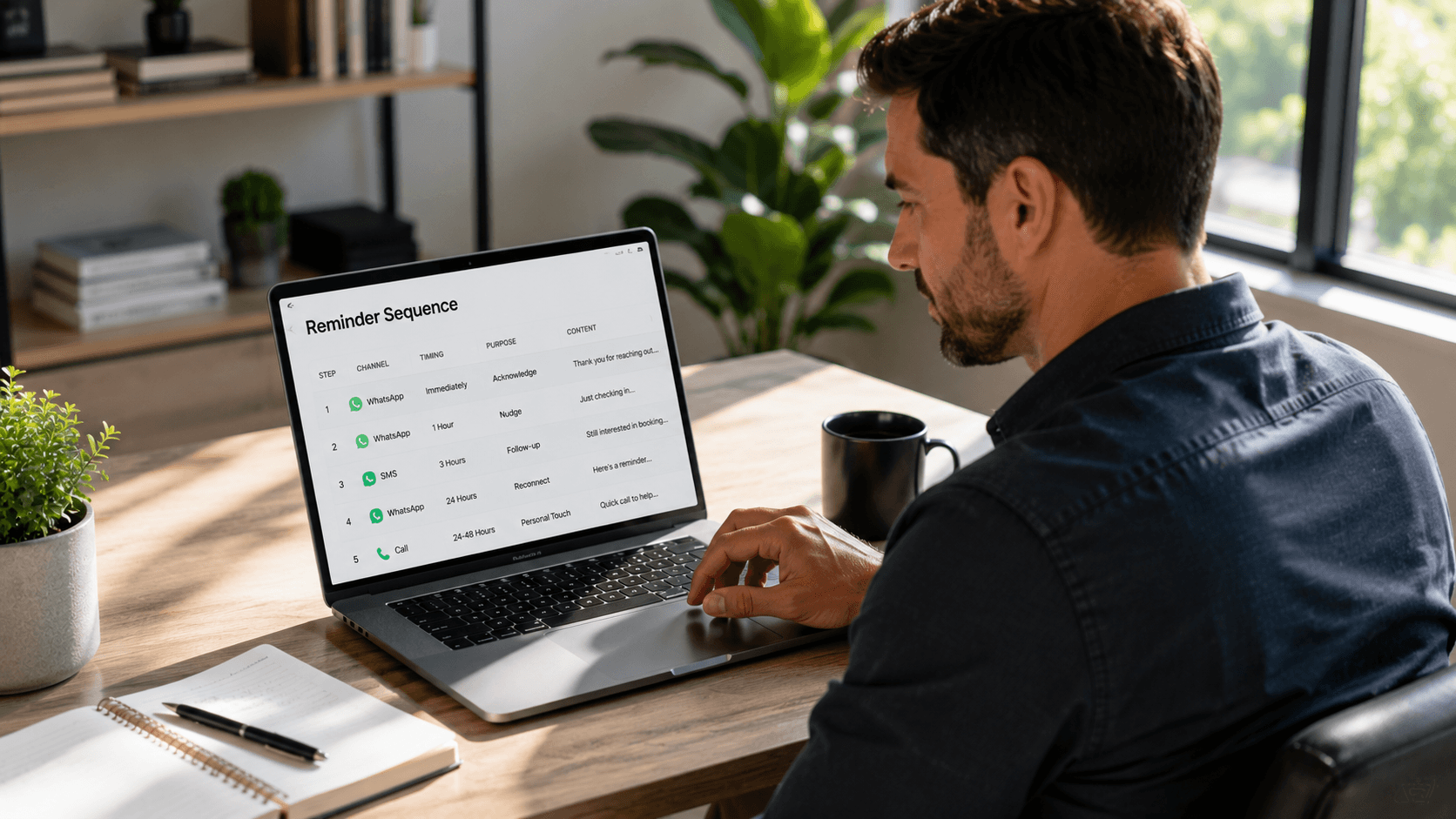
A generic reminder, one message sent the day before with the appointment time and address, addresses none of these causes properly. It is better than nothing, but it is a long way from optimal.
An effective reminder sequence is designed around the causes, not just the calendar.
For the timing cause: a re-engagement message sent seven days out that rebuilds anticipation and brings the appointment back into focus.
For the clarity cause: a practical information message sent two to three days out that removes uncertainty about what to expect and what to prepare.
For the friction cause: a same-day reminder that includes a simple reschedule option, making it easy to rearrange rather than silently not attend.
For the commitment cause: this is addressed before the reminder sequence begins, through the quality of the booking journey itself. But a confirmation message immediately after booking that requires an active response, a simple yes or reply to confirm, adds a commitment step that raises the weight of the booking.
Three to four touchpoints across the window between booking and appointment, each one purposeful and specific, is substantially more effective than a single generic reminder.
What Not to Do
A few common reminder mistakes are worth naming directly because they are widespread and each one makes the problem worse.
Sending every reminder on the same channel. If a client does not open emails, a reminder sequence that relies entirely on email will fail regardless of how well it is written. A multi-channel approach, typically a combination of WhatsApp, SMS and email depending on the client's preference and engagement history, reaches more clients more reliably.
Making reminders feel automated and impersonal. A message that reads like a system notification rather than a communication from a real business reduces the sense of personal accountability that holds appointments together. Warm, specific and brand-consistent language matters even in a short reminder.
Not including a contact option. A reminder that delivers information but offers no way to respond, ask a question or reschedule creates a dead end for clients who have something they need to raise. Always include a simple response route.
Sending too many reminders too close together. A reminder sent four days out, three days out, two days out and the morning of the appointment is too much for most services. It signals anxiety rather than care and can prompt a client to reschedule purely to stop the messages. Match the frequency to the booking lead time and the nature of the service.
How Reminders Address Each Cause Specifically
A generic reminder, one message sent the day before with the appointment time and address, addresses none of these causes properly. It is better than nothing, but it is a long way from optimal.
An effective reminder sequence is designed around the causes, not just the calendar.
For the timing cause: a re-engagement message sent seven days out that rebuilds anticipation and brings the appointment back into focus.
For the clarity cause: a practical information message sent two to three days out that removes uncertainty about what to expect and what to prepare.
For the friction cause: a same-day reminder that includes a simple reschedule option, making it easy to rearrange rather than silently not attend.
For the commitment cause: this is addressed before the reminder sequence begins, through the quality of the booking journey itself. But a confirmation message immediately after booking that requires an active response, a simple yes or reply to confirm, adds a commitment step that raises the weight of the booking.
Three to four touchpoints across the window between booking and appointment, each one purposeful and specific, is substantially more effective than a single generic reminder.
What Not to Do
A few common reminder mistakes are worth naming directly because they are widespread and each one makes the problem worse.
Sending every reminder on the same channel. If a client does not open emails, a reminder sequence that relies entirely on email will fail regardless of how well it is written. A multi-channel approach, typically a combination of WhatsApp, SMS and email depending on the client's preference and engagement history, reaches more clients more reliably.
Making reminders feel automated and impersonal. A message that reads like a system notification rather than a communication from a real business reduces the sense of personal accountability that holds appointments together. Warm, specific and brand-consistent language matters even in a short reminder.
Not including a contact option. A reminder that delivers information but offers no way to respond, ask a question or reschedule creates a dead end for clients who have something they need to raise. Always include a simple response route.
Sending too many reminders too close together. A reminder sent four days out, three days out, two days out and the morning of the appointment is too much for most services. It signals anxiety rather than care and can prompt a client to reschedule purely to stop the messages. Match the frequency to the booking lead time and the nature of the service.
How Reminders Address Each Cause Specifically
A generic reminder, one message sent the day before with the appointment time and address, addresses none of these causes properly. It is better than nothing, but it is a long way from optimal.
An effective reminder sequence is designed around the causes, not just the calendar.
For the timing cause: a re-engagement message sent seven days out that rebuilds anticipation and brings the appointment back into focus.
For the clarity cause: a practical information message sent two to three days out that removes uncertainty about what to expect and what to prepare.
For the friction cause: a same-day reminder that includes a simple reschedule option, making it easy to rearrange rather than silently not attend.
For the commitment cause: this is addressed before the reminder sequence begins, through the quality of the booking journey itself. But a confirmation message immediately after booking that requires an active response, a simple yes or reply to confirm, adds a commitment step that raises the weight of the booking.
Three to four touchpoints across the window between booking and appointment, each one purposeful and specific, is substantially more effective than a single generic reminder.
What Not to Do
A few common reminder mistakes are worth naming directly because they are widespread and each one makes the problem worse.
Sending every reminder on the same channel. If a client does not open emails, a reminder sequence that relies entirely on email will fail regardless of how well it is written. A multi-channel approach, typically a combination of WhatsApp, SMS and email depending on the client's preference and engagement history, reaches more clients more reliably.
Making reminders feel automated and impersonal. A message that reads like a system notification rather than a communication from a real business reduces the sense of personal accountability that holds appointments together. Warm, specific and brand-consistent language matters even in a short reminder.
Not including a contact option. A reminder that delivers information but offers no way to respond, ask a question or reschedule creates a dead end for clients who have something they need to raise. Always include a simple response route.
Sending too many reminders too close together. A reminder sent four days out, three days out, two days out and the morning of the appointment is too much for most services. It signals anxiety rather than care and can prompt a client to reschedule purely to stop the messages. Match the frequency to the booking lead time and the nature of the service.
FAQ
What is a good show rate target for appointment businesses?
Above 90% is the green zone for most premium appointment businesses. Between 80 and 90% is manageable but leaves meaningful revenue on the table. Below 80% is a clear signal that one or more of the four causes above is active and unaddressed.
Does taking a deposit really reduce no-shows?
Yes, consistently. A deposit creates a financial stake in the appointment that changes the psychology of cancellation. The lead has to actively decide to forfeit something, rather than simply not showing up at no cost to themselves. Even a modest deposit has a measurable impact on show rates.
Should reminders be automated or sent manually?
Automated, for consistency. A manual reminder process depends on someone remembering to send it at the right time and doing so every time. Automation ensures every client receives the right messages at the right intervals regardless of how busy the team is.
What channel works best for appointment reminders?
WhatsApp has the highest open and response rates for most appointment businesses in the UK. SMS is a reliable fallback. Email works for clients who engage with it but should not be the sole channel for time-sensitive reminders.
FAQ
What is a good show rate target for appointment businesses?
Above 90% is the green zone for most premium appointment businesses. Between 80 and 90% is manageable but leaves meaningful revenue on the table. Below 80% is a clear signal that one or more of the four causes above is active and unaddressed.
Does taking a deposit really reduce no-shows?
Yes, consistently. A deposit creates a financial stake in the appointment that changes the psychology of cancellation. The lead has to actively decide to forfeit something, rather than simply not showing up at no cost to themselves. Even a modest deposit has a measurable impact on show rates.
Should reminders be automated or sent manually?
Automated, for consistency. A manual reminder process depends on someone remembering to send it at the right time and doing so every time. Automation ensures every client receives the right messages at the right intervals regardless of how busy the team is.
What channel works best for appointment reminders?
WhatsApp has the highest open and response rates for most appointment businesses in the UK. SMS is a reliable fallback. Email works for clients who engage with it but should not be the sole channel for time-sensitive reminders.
FAQ
What is a good show rate target for appointment businesses?
Above 90% is the green zone for most premium appointment businesses. Between 80 and 90% is manageable but leaves meaningful revenue on the table. Below 80% is a clear signal that one or more of the four causes above is active and unaddressed.
Does taking a deposit really reduce no-shows?
Yes, consistently. A deposit creates a financial stake in the appointment that changes the psychology of cancellation. The lead has to actively decide to forfeit something, rather than simply not showing up at no cost to themselves. Even a modest deposit has a measurable impact on show rates.
Should reminders be automated or sent manually?
Automated, for consistency. A manual reminder process depends on someone remembering to send it at the right time and doing so every time. Automation ensures every client receives the right messages at the right intervals regardless of how busy the team is.
What channel works best for appointment reminders?
WhatsApp has the highest open and response rates for most appointment businesses in the UK. SMS is a reliable fallback. Email works for clients who engage with it but should not be the sole channel for time-sensitive reminders.