
Why 'Invisible Search' Is Real (And How to Fix It)
Why 'Invisible Search' Is Real (And How to Fix It)
Why 'Invisible Search' Is Real (And How to Fix It)
Your business might be running perfectly. The service is excellent, the team is skilled, the reviews are good. And yet a growing number of potential clients who are actively looking for exactly what you offer are finding someone else, not because your competitors are better but because they are more visible in the places where the search is now happening. Invisible search is the gap between how often your target clients are searching for your type of service and how often your business appears in the results they see. It is not a rankings failure in the traditional sense. It is a visibility failure in a new layer of search that most local businesses have not yet prepared for. This post explains what the symptoms look like, why directories so often appear ahead of individual business websites in AI answers and the quick wins that start closing the gap without a website rebuild.
What Invisible Search Actually Means
The term invisible search refers to search activity that is directly relevant to your business but results in your business not appearing. The potential client searched. The intent was there. The business did not show up in the answer they received.
This is different from a low ranking in traditional search results, where you appear somewhere on page two or three and could theoretically be found if someone scrolled far enough. In AI-generated answers, the result is binary. Your business either appears in the answer or it does not. There is no page two. The AI constructs a response and names the businesses it is most confident recommending based on the information available to it. If your information is not clear, complete or well-organised enough, you are simply not in the answer.
What Invisible Search Actually Means
The term invisible search refers to search activity that is directly relevant to your business but results in your business not appearing. The potential client searched. The intent was there. The business did not show up in the answer they received.
This is different from a low ranking in traditional search results, where you appear somewhere on page two or three and could theoretically be found if someone scrolled far enough. In AI-generated answers, the result is binary. Your business either appears in the answer or it does not. There is no page two. The AI constructs a response and names the businesses it is most confident recommending based on the information available to it. If your information is not clear, complete or well-organised enough, you are simply not in the answer.
What Invisible Search Actually Means
The term invisible search refers to search activity that is directly relevant to your business but results in your business not appearing. The potential client searched. The intent was there. The business did not show up in the answer they received.
This is different from a low ranking in traditional search results, where you appear somewhere on page two or three and could theoretically be found if someone scrolled far enough. In AI-generated answers, the result is binary. Your business either appears in the answer or it does not. There is no page two. The AI constructs a response and names the businesses it is most confident recommending based on the information available to it. If your information is not clear, complete or well-organised enough, you are simply not in the answer.
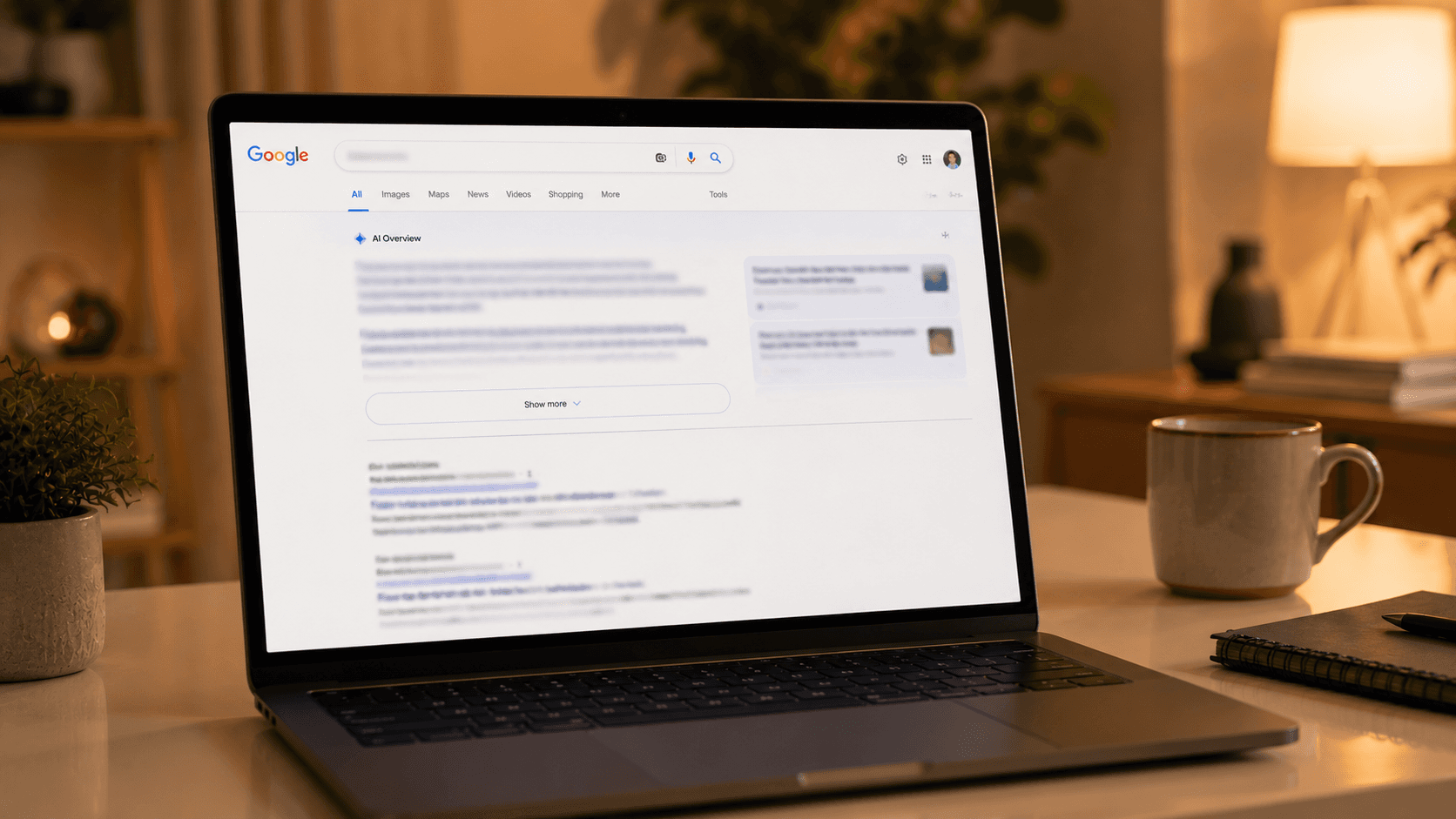
For local appointment businesses, this is particularly consequential because the searches being performed are high-intent. Someone asking "best aesthetic clinic for Morpheus8 in [city]" or "where to get ceramic coating done in [area]" is close to a booking decision. They are not browsing generally. They are trying to identify a specific business to contact. If your business does not appear in the answer they receive, that lead goes somewhere else before you ever knew it existed.
For local appointment businesses, this is particularly consequential because the searches being performed are high-intent. Someone asking "best aesthetic clinic for Morpheus8 in [city]" or "where to get ceramic coating done in [area]" is close to a booking decision. They are not browsing generally. They are trying to identify a specific business to contact. If your business does not appear in the answer they receive, that lead goes somewhere else before you ever knew it existed.
The Symptoms That Tell You It Is Happening
Unlike a drop in website traffic, which shows up clearly in analytics, invisible search is harder to detect because you are not seeing the leads you are losing. There is no notification that says a potential client looked for your service and found someone else. The absence of a lead is invisible by definition.
There are, however, several indirect symptoms that suggest invisible search is costing your business enquiries.
Your enquiry volume feels flat despite your marketing being consistent. You are running ads, maintaining social media and keeping your website reasonably up to date, but the flow of organic enquiries has not grown as you might have expected. Some of the demand that should be finding you organically is being intercepted before it reaches your website.
Competitors you know to be less established or less highly regarded than your business seem to appear more prominently when you test relevant AI search queries. Their information is more clearly organised and more consistently presented across their online profiles, even if your underlying service quality is higher.
When you ask an AI tool a question that should clearly lead to your business, the answer either names a competitor, names a directory listing that mentions your business but does not highlight it, or gives a generic answer that helps nobody. Your specific name, location and services are not present in the response.
The Symptoms That Tell You It Is Happening
Unlike a drop in website traffic, which shows up clearly in analytics, invisible search is harder to detect because you are not seeing the leads you are losing. There is no notification that says a potential client looked for your service and found someone else. The absence of a lead is invisible by definition.
There are, however, several indirect symptoms that suggest invisible search is costing your business enquiries.
Your enquiry volume feels flat despite your marketing being consistent. You are running ads, maintaining social media and keeping your website reasonably up to date, but the flow of organic enquiries has not grown as you might have expected. Some of the demand that should be finding you organically is being intercepted before it reaches your website.
Competitors you know to be less established or less highly regarded than your business seem to appear more prominently when you test relevant AI search queries. Their information is more clearly organised and more consistently presented across their online profiles, even if your underlying service quality is higher.
When you ask an AI tool a question that should clearly lead to your business, the answer either names a competitor, names a directory listing that mentions your business but does not highlight it, or gives a generic answer that helps nobody. Your specific name, location and services are not present in the response.
The Symptoms That Tell You It Is Happening
Unlike a drop in website traffic, which shows up clearly in analytics, invisible search is harder to detect because you are not seeing the leads you are losing. There is no notification that says a potential client looked for your service and found someone else. The absence of a lead is invisible by definition.
There are, however, several indirect symptoms that suggest invisible search is costing your business enquiries.
Your enquiry volume feels flat despite your marketing being consistent. You are running ads, maintaining social media and keeping your website reasonably up to date, but the flow of organic enquiries has not grown as you might have expected. Some of the demand that should be finding you organically is being intercepted before it reaches your website.
Competitors you know to be less established or less highly regarded than your business seem to appear more prominently when you test relevant AI search queries. Their information is more clearly organised and more consistently presented across their online profiles, even if your underlying service quality is higher.
When you ask an AI tool a question that should clearly lead to your business, the answer either names a competitor, names a directory listing that mentions your business but does not highlight it, or gives a generic answer that helps nobody. Your specific name, location and services are not present in the response.
You have not updated your Google Business Profile in a significant amount of time, your service page descriptions are brief and not written in a question-and-answer format, and you have no FAQ content on your website. These are the most common structural conditions that produce invisible search.
You have not updated your Google Business Profile in a significant amount of time, your service page descriptions are brief and not written in a question-and-answer format, and you have no FAQ content on your website. These are the most common structural conditions that produce invisible search.

Why Directories So Often Win Over Individual Business Websites
One of the more frustrating aspects of invisible search for local business owners is discovering that a directory listing, often one they did not personally create or manage, is appearing in AI answers about their service category while their own website is not.
This happens for a logical reason. Directories like Treatwell, Fresha, RealSelf, Healthgrades and category-specific listing sites have enormous domain authority, consistent data structures, high volumes of recent content and a proven track record of being trusted sources for AI tools. When an AI is constructing an answer to a local service query and needs to name specific businesses, it is more likely to draw from a trusted, structured directory than from an individual small business website whose information may be sparse, inconsistently structured or infrequently updated.
This is not a problem that individual businesses can fully overcome by competing directly with directories on domain authority. It is a problem that can be addressed by two different approaches used in combination.
The first is ensuring your directory listings are fully completed, accurate and up to date. A Fresha or Treatwell or Healthgrades listing that is thin, has no service descriptions and carries old information is not helping your AI visibility even though you technically appear there. A listing that is fully completed with specific service descriptions, accurate pricing guidance, recent reviews and a current booking link is a different proposition entirely. That listing can represent your business well in an AI answer even when it appears rather than your direct website.
The second is improving your own website to the point where it can compete with directory quality for AI readability. Not in terms of size or authority, but in terms of clarity, specificity and structure. A small business website that answers the 10 questions from Blog 22 clearly and consistently is significantly more likely to appear in AI answers than one that does not, even against directory competition.
Quick Wins: FAQs and Structure That AI Can Use
The most impactful changes most local businesses can make to their AI visibility are also the most straightforward. They do not require a new website, a new platform or a technical team. They require additions to existing pages that make the information already on your site easier for AI tools to read and use.
Add an FAQ section to your most important service pages.
Each FAQ should address a genuine question a potential client would ask before enquiring. Not "why should I choose you?" which is marketing copy masquerading as a question, but "how long does the treatment take?", "will I need downtime?" or "is this suitable for first-time clients?" These are the questions being asked in search, and a page that answers them clearly is more likely to appear in response to those queries.
A good FAQ section for a service page has between five and eight questions, each one a real query written in natural language, and each answer direct, specific and accurate. Two or three sentences per answer is sufficient. The goal is clarity, not length.
Structure your service page content around questions rather than features.
A service page that reads "our state-of-the-art Morpheus8 treatment delivers transformative results for skin lifting and tightening" is marketing copy. A page that reads "what does Morpheus8 treat? Morpheus8 is used for skin laxity, fine lines, acne scarring and overall skin quality improvement" is a question-and-answer format that an AI tool can extract and use directly in a response.
The information is often the same. The structure is what changes. Moving from feature-led to question-and-answer-led formatting on key service pages is one of the single highest-impact AEO changes a local business can make.
Ensure your Google Business Profile is fully completed.
Fill in every available field. Add your services individually with descriptions. Use the Q&A feature to add and answer common questions. Respond to recent reviews. Check that your booking link is present and working. Update your hours if anything has changed. This takes less than an hour for most businesses and is frequently the fastest route to improved AI answer visibility, because the Google Business Profile is one of the primary sources AI tools draw from for local business information.
Check consistency across your main directory listings.
Your business name, address, phone number and website URL should be identical across every directory and listing site you appear on. Even minor inconsistencies, a slightly different trading name, an old phone number on an unclaimed listing, create uncertainty for AI tools and reduce the confidence with which they can represent your business. A consistency check across your five or six most important directory listings is a quick audit with a direct impact on AI visibility.
Why Directories So Often Win Over Individual Business Websites
One of the more frustrating aspects of invisible search for local business owners is discovering that a directory listing, often one they did not personally create or manage, is appearing in AI answers about their service category while their own website is not.
This happens for a logical reason. Directories like Treatwell, Fresha, RealSelf, Healthgrades and category-specific listing sites have enormous domain authority, consistent data structures, high volumes of recent content and a proven track record of being trusted sources for AI tools. When an AI is constructing an answer to a local service query and needs to name specific businesses, it is more likely to draw from a trusted, structured directory than from an individual small business website whose information may be sparse, inconsistently structured or infrequently updated.
This is not a problem that individual businesses can fully overcome by competing directly with directories on domain authority. It is a problem that can be addressed by two different approaches used in combination.
The first is ensuring your directory listings are fully completed, accurate and up to date. A Fresha or Treatwell or Healthgrades listing that is thin, has no service descriptions and carries old information is not helping your AI visibility even though you technically appear there. A listing that is fully completed with specific service descriptions, accurate pricing guidance, recent reviews and a current booking link is a different proposition entirely. That listing can represent your business well in an AI answer even when it appears rather than your direct website.
The second is improving your own website to the point where it can compete with directory quality for AI readability. Not in terms of size or authority, but in terms of clarity, specificity and structure. A small business website that answers the 10 questions from Blog 22 clearly and consistently is significantly more likely to appear in AI answers than one that does not, even against directory competition.
Quick Wins: FAQs and Structure That AI Can Use
The most impactful changes most local businesses can make to their AI visibility are also the most straightforward. They do not require a new website, a new platform or a technical team. They require additions to existing pages that make the information already on your site easier for AI tools to read and use.
Add an FAQ section to your most important service pages.
Each FAQ should address a genuine question a potential client would ask before enquiring. Not "why should I choose you?" which is marketing copy masquerading as a question, but "how long does the treatment take?", "will I need downtime?" or "is this suitable for first-time clients?" These are the questions being asked in search, and a page that answers them clearly is more likely to appear in response to those queries.
A good FAQ section for a service page has between five and eight questions, each one a real query written in natural language, and each answer direct, specific and accurate. Two or three sentences per answer is sufficient. The goal is clarity, not length.
Structure your service page content around questions rather than features.
A service page that reads "our state-of-the-art Morpheus8 treatment delivers transformative results for skin lifting and tightening" is marketing copy. A page that reads "what does Morpheus8 treat? Morpheus8 is used for skin laxity, fine lines, acne scarring and overall skin quality improvement" is a question-and-answer format that an AI tool can extract and use directly in a response.
The information is often the same. The structure is what changes. Moving from feature-led to question-and-answer-led formatting on key service pages is one of the single highest-impact AEO changes a local business can make.
Ensure your Google Business Profile is fully completed.
Fill in every available field. Add your services individually with descriptions. Use the Q&A feature to add and answer common questions. Respond to recent reviews. Check that your booking link is present and working. Update your hours if anything has changed. This takes less than an hour for most businesses and is frequently the fastest route to improved AI answer visibility, because the Google Business Profile is one of the primary sources AI tools draw from for local business information.
Check consistency across your main directory listings.
Your business name, address, phone number and website URL should be identical across every directory and listing site you appear on. Even minor inconsistencies, a slightly different trading name, an old phone number on an unclaimed listing, create uncertainty for AI tools and reduce the confidence with which they can represent your business. A consistency check across your five or six most important directory listings is a quick audit with a direct impact on AI visibility.
Why Directories So Often Win Over Individual Business Websites
One of the more frustrating aspects of invisible search for local business owners is discovering that a directory listing, often one they did not personally create or manage, is appearing in AI answers about their service category while their own website is not.
This happens for a logical reason. Directories like Treatwell, Fresha, RealSelf, Healthgrades and category-specific listing sites have enormous domain authority, consistent data structures, high volumes of recent content and a proven track record of being trusted sources for AI tools. When an AI is constructing an answer to a local service query and needs to name specific businesses, it is more likely to draw from a trusted, structured directory than from an individual small business website whose information may be sparse, inconsistently structured or infrequently updated.
This is not a problem that individual businesses can fully overcome by competing directly with directories on domain authority. It is a problem that can be addressed by two different approaches used in combination.
The first is ensuring your directory listings are fully completed, accurate and up to date. A Fresha or Treatwell or Healthgrades listing that is thin, has no service descriptions and carries old information is not helping your AI visibility even though you technically appear there. A listing that is fully completed with specific service descriptions, accurate pricing guidance, recent reviews and a current booking link is a different proposition entirely. That listing can represent your business well in an AI answer even when it appears rather than your direct website.
The second is improving your own website to the point where it can compete with directory quality for AI readability. Not in terms of size or authority, but in terms of clarity, specificity and structure. A small business website that answers the 10 questions from Blog 22 clearly and consistently is significantly more likely to appear in AI answers than one that does not, even against directory competition.
Quick Wins: FAQs and Structure That AI Can Use
The most impactful changes most local businesses can make to their AI visibility are also the most straightforward. They do not require a new website, a new platform or a technical team. They require additions to existing pages that make the information already on your site easier for AI tools to read and use.
Add an FAQ section to your most important service pages.
Each FAQ should address a genuine question a potential client would ask before enquiring. Not "why should I choose you?" which is marketing copy masquerading as a question, but "how long does the treatment take?", "will I need downtime?" or "is this suitable for first-time clients?" These are the questions being asked in search, and a page that answers them clearly is more likely to appear in response to those queries.
A good FAQ section for a service page has between five and eight questions, each one a real query written in natural language, and each answer direct, specific and accurate. Two or three sentences per answer is sufficient. The goal is clarity, not length.
Structure your service page content around questions rather than features.
A service page that reads "our state-of-the-art Morpheus8 treatment delivers transformative results for skin lifting and tightening" is marketing copy. A page that reads "what does Morpheus8 treat? Morpheus8 is used for skin laxity, fine lines, acne scarring and overall skin quality improvement" is a question-and-answer format that an AI tool can extract and use directly in a response.
The information is often the same. The structure is what changes. Moving from feature-led to question-and-answer-led formatting on key service pages is one of the single highest-impact AEO changes a local business can make.
Ensure your Google Business Profile is fully completed.
Fill in every available field. Add your services individually with descriptions. Use the Q&A feature to add and answer common questions. Respond to recent reviews. Check that your booking link is present and working. Update your hours if anything has changed. This takes less than an hour for most businesses and is frequently the fastest route to improved AI answer visibility, because the Google Business Profile is one of the primary sources AI tools draw from for local business information.
Check consistency across your main directory listings.
Your business name, address, phone number and website URL should be identical across every directory and listing site you appear on. Even minor inconsistencies, a slightly different trading name, an old phone number on an unclaimed listing, create uncertainty for AI tools and reduce the confidence with which they can represent your business. A consistency check across your five or six most important directory listings is a quick audit with a direct impact on AI visibility.

The Practical Fix Plan
If you are starting from scratch on AEO, the priority order is clear.
Start with your Google Business Profile. Complete every field, add services with descriptions, check that everything is current and accurate. This is where the highest-impact improvement happens most quickly.
Then audit your top three to five directory listings for completeness and consistency. Fix the gaps and correct the inconsistencies.
Then add FAQ content to your two or three most important service pages. Write the questions in the language your clients use, not in marketing language.
Then review your service page structures for question-and-answer opportunities and make the targeted additions that improve readability for both humans and AI tools.
That sequence covers the foundational AEO work for most local appointment businesses within a few focused sessions, without any technical development required.
The Practical Fix Plan
If you are starting from scratch on AEO, the priority order is clear.
Start with your Google Business Profile. Complete every field, add services with descriptions, check that everything is current and accurate. This is where the highest-impact improvement happens most quickly.
Then audit your top three to five directory listings for completeness and consistency. Fix the gaps and correct the inconsistencies.
Then add FAQ content to your two or three most important service pages. Write the questions in the language your clients use, not in marketing language.
Then review your service page structures for question-and-answer opportunities and make the targeted additions that improve readability for both humans and AI tools.
That sequence covers the foundational AEO work for most local appointment businesses within a few focused sessions, without any technical development required.
The Practical Fix Plan
If you are starting from scratch on AEO, the priority order is clear.
Start with your Google Business Profile. Complete every field, add services with descriptions, check that everything is current and accurate. This is where the highest-impact improvement happens most quickly.
Then audit your top three to five directory listings for completeness and consistency. Fix the gaps and correct the inconsistencies.
Then add FAQ content to your two or three most important service pages. Write the questions in the language your clients use, not in marketing language.
Then review your service page structures for question-and-answer opportunities and make the targeted additions that improve readability for both humans and AI tools.
That sequence covers the foundational AEO work for most local appointment businesses within a few focused sessions, without any technical development required.
FAQ
How do I know which AI tools are sending traffic to competitors?
Directly testing the most relevant queries in ChatGPT, Perplexity and Google is the most reliable method. Check for your business name, your competitor names and the quality of information provided for each. Consistent competitor presence across multiple AI tools is a clear signal that their content structure is ahead of yours.
Can I get removed from a directory that is misrepresenting my business?
Most major directories allow you to claim and edit your listing. Claiming and correcting an inaccurate listing is faster and more effective than trying to have it removed. An accurate, well-completed listing is also better for your AI visibility than an absent one.
Does paying for premium directory listings improve AI visibility?
Paid directory listings typically improve your visibility to human searchers on that specific platform. The effect on AI search visibility is less direct, though a more prominent listing with better content is more likely to be cited. The highest return on directory investment is usually in completing free listings to a high standard before considering paid placements.
How do I know if my FAQ content is the right format for AI tools?
Write questions in natural language the way a real person would ask them, not in formal or technical language. Keep answers specific and factual rather than promotional. Avoid padding and get to the useful information quickly. These are the formatting signals that make content easy for AI to extract and use.
FAQ
How do I know which AI tools are sending traffic to competitors?
Directly testing the most relevant queries in ChatGPT, Perplexity and Google is the most reliable method. Check for your business name, your competitor names and the quality of information provided for each. Consistent competitor presence across multiple AI tools is a clear signal that their content structure is ahead of yours.
Can I get removed from a directory that is misrepresenting my business?
Most major directories allow you to claim and edit your listing. Claiming and correcting an inaccurate listing is faster and more effective than trying to have it removed. An accurate, well-completed listing is also better for your AI visibility than an absent one.
Does paying for premium directory listings improve AI visibility?
Paid directory listings typically improve your visibility to human searchers on that specific platform. The effect on AI search visibility is less direct, though a more prominent listing with better content is more likely to be cited. The highest return on directory investment is usually in completing free listings to a high standard before considering paid placements.
How do I know if my FAQ content is the right format for AI tools?
Write questions in natural language the way a real person would ask them, not in formal or technical language. Keep answers specific and factual rather than promotional. Avoid padding and get to the useful information quickly. These are the formatting signals that make content easy for AI to extract and use.
FAQ
How do I know which AI tools are sending traffic to competitors?
Directly testing the most relevant queries in ChatGPT, Perplexity and Google is the most reliable method. Check for your business name, your competitor names and the quality of information provided for each. Consistent competitor presence across multiple AI tools is a clear signal that their content structure is ahead of yours.
Can I get removed from a directory that is misrepresenting my business?
Most major directories allow you to claim and edit your listing. Claiming and correcting an inaccurate listing is faster and more effective than trying to have it removed. An accurate, well-completed listing is also better for your AI visibility than an absent one.
Does paying for premium directory listings improve AI visibility?
Paid directory listings typically improve your visibility to human searchers on that specific platform. The effect on AI search visibility is less direct, though a more prominent listing with better content is more likely to be cited. The highest return on directory investment is usually in completing free listings to a high standard before considering paid placements.
How do I know if my FAQ content is the right format for AI tools?
Write questions in natural language the way a real person would ask them, not in formal or technical language. Keep answers specific and factual rather than promotional. Avoid padding and get to the useful information quickly. These are the formatting signals that make content easy for AI to extract and use.