
Your Google Business Profile Is Now an AI Data Source
Your Google Business Profile Is Now an AI Data Source
Your Google Business Profile Is Now an AI Data Source
Most local business owners think of their Google Business Profile as a listing. A place where the address, phone number and opening hours sit so that people can find you on Google Maps. That understanding was accurate three years ago. It is significantly incomplete today. Your Google Business Profile has become one of the primary sources AI tools draw from when constructing answers to local service queries. When someone asks Google, ChatGPT or another AI-powered tool about businesses like yours in your area, your GBP is often one of the first places that tool looks for specific, structured information about what you offer, where you are and how to reach you. A profile that is thin, outdated or incomplete is not just a missed opportunity on Google Maps. It is a direct contributor to your business being absent from AI answers that your potential clients are seeing right now. This post covers what has changed, which parts of your profile matter most for AI visibility and the consistency rules that determine whether the information you have in place is actually working for you.
How the Google Business Profile Has Evolved
The original purpose of Google Business Profile was straightforward. It created a structured, standardised listing that Google could display when someone searched for a specific business or a category of business near a particular location. The fields were basic: name, address, phone number, category, hours.
Over time, Google added more structure. Services, products, attributes, photos, reviews, posts, booking links, Q&A sections. Each addition gave businesses more ways to communicate information and gave Google more structured data to work with. But for most local businesses, these additional fields remained largely ignored. The name and hours were filled in and everything else was treated as optional.
The expansion of AI-generated answers in Google Search has changed the value of every one of those additional fields. When Google constructs an AI Overview in response to a local service query, it draws from structured, specific information. A profile that only contains a name, address and phone number cannot contribute much to that answer. A profile that includes specific service descriptions, a completed Q&A section, recent reviews mentioning specific treatments and a direct booking link can contribute a great deal.
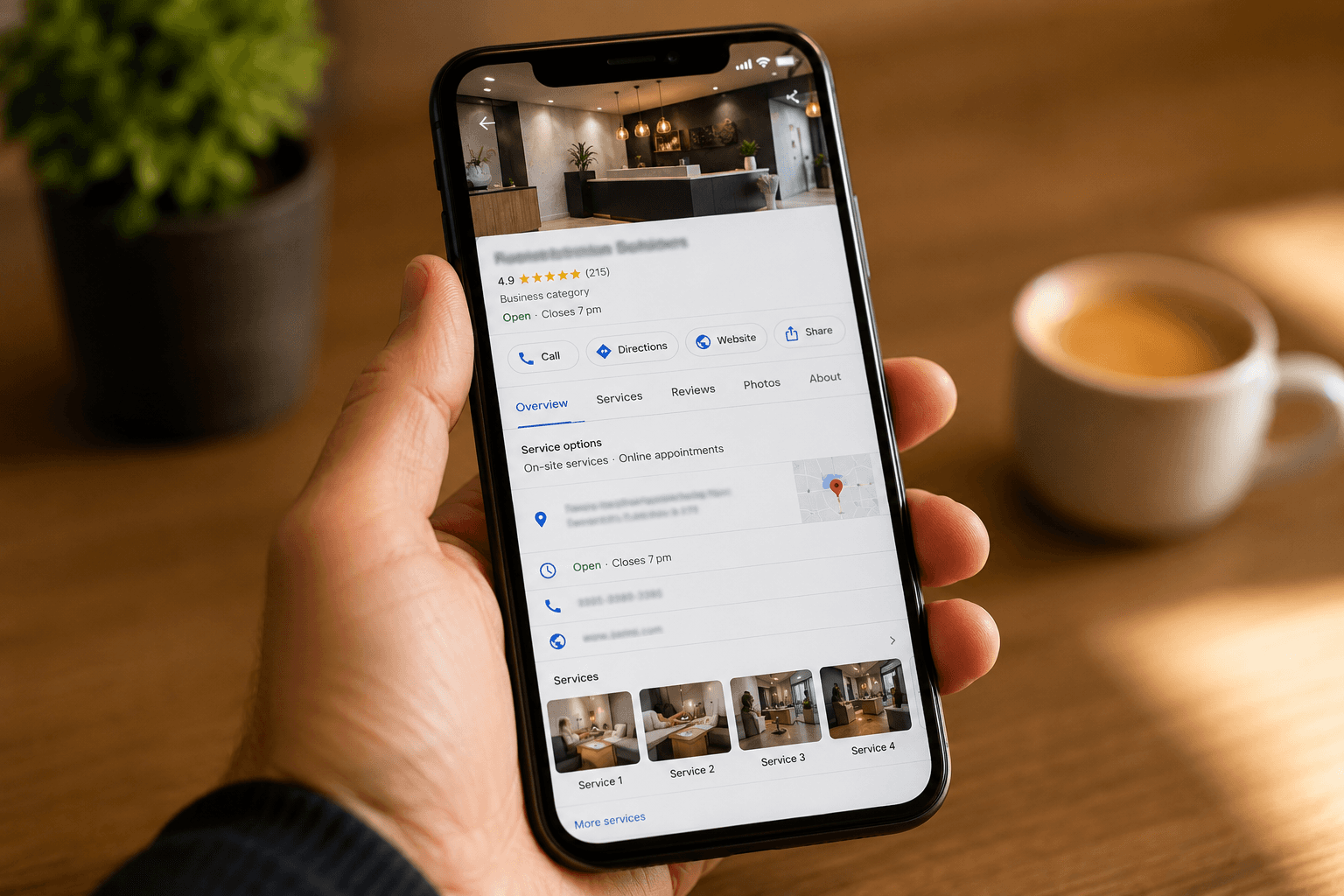
The businesses whose GBP information is richest and most accurately structured are the ones most likely to appear in AI-generated local answers. That is no longer a nice-to-have. It is the practical difference between being included in the discovery moment and being invisible during it.
The businesses whose GBP information is richest and most accurately structured are the ones most likely to appear in AI-generated local answers. That is no longer a nice-to-have. It is the practical difference between being included in the discovery moment and being invisible during it.
Why GBP Matters More Than It Did Two Years Ago
The shift is not just about Google. Because Google's AI tools, including the AI Overview feature in search results, are among the most widely used AI-generated answer surfaces for local queries, your GBP data is feeding into one of the highest-traffic local discovery channels that exists.
When someone asks Google "best Morpheus8 clinic near me" or "where can I get PPF done in Manchester" or "luxury travel agent in London", the AI Overview that may appear at the top of the results is drawing from GBP data as a primary source. The businesses that appear in that overview are not necessarily the ones with the highest-authority websites. They are often the ones with the most complete and clearly structured GBP data.
This means that for many local appointment businesses, improving the GBP is a higher-return investment right now than almost any other SEO activity. It does not require a developer, a significant budget or months of effort. It requires a focused audit and a structured improvement session that most business owners can complete themselves in under two hours.
This means that for many local appointment businesses, improving the GBP is a higher-return investment right now than almost any other SEO activity. It does not require a developer, a significant budget or months of effort. It requires a focused audit and a structured improvement session that most business owners can complete themselves in under two hours.
The Sections That Matter Most for AI Visibility
Not every field in a GBP carries equal weight for AI answer construction. The sections below are the ones that have the most direct influence on whether and how your business appears in AI-generated local search responses.
Services with specific descriptions
The Services section of your GBP allows you to list every service you offer with a name, a price or price range and a description of up to 300 words. Most businesses fill in the name and leave the description blank. That blank description is a missed opportunity to provide the specific information AI tools need to understand what you offer and match it to relevant queries.
Each service description should explain what the service is, who it is for and what a client can expect. Write these in natural, specific language rather than marketing copy. "Morpheus8 is a radiofrequency microneedling treatment used for skin tightening, improving skin texture and reducing fine lines. Suitable for most skin types and requires no downtime" is genuinely useful information. "Our premium Morpheus8 treatment delivers transformative results" is not.
The Q&A section
The Q&A section is one of the most underused and highest-impact parts of any GBP. Anyone can submit a question and anyone can answer it, which means businesses that have not populated this section may have unanswered questions sitting there, or worse, questions answered incorrectly by third parties.
The right approach is to populate the Q&A section yourself with the questions your clients most commonly ask before booking, and to provide accurate, specific answers to each one. Think of it as a public FAQ that AI tools can draw from directly. Questions about suitability, pricing, booking process, preparation and results are all relevant here.
Booking links
A direct booking link in your GBP removes friction between an AI answer that mentions your business and the client actually booking with you. Without it, the client has to navigate from the GBP to your website and find the booking route from there. Each additional step reduces conversion.
If your booking system, whether Fresha, Phorest, Cliniko, Timely, Calendly or any other platform, supports a direct booking URL, that URL should be in your GBP. Google explicitly supports booking links in the profile and surfaces them prominently in local search results.
Opening hours and special hours
Outdated or incorrect opening hours are one of the most common accuracy problems in local GBPs and one of the most damaging for AI confidence. An AI tool that is unsure whether your business is currently open based on inconsistent data across your profile and other sources is less likely to recommend you confidently. Keep your standard hours current and use the special hours feature for bank holidays, seasonal changes and any temporary variations.
Recent reviews mentioning specific services
Review content is indexed by Google and contributes to the understanding of what a business specialises in and how well regarded it is. A review profile where recent reviews mention specific treatments by name, such as "had Morpheus8 done here" or "best ceramic coating in the area", gives AI tools additional confirmation of your service categories and quality signals.
This is where the post-appointment review sequence from Blog 20 connects directly to your AEO strategy. Reviews that are specific, recent and genuine are not just social proof for human visitors. They are structured data contributions to your AI visibility.

Consistency Rules: Why Inconsistency Damages AI Confidence
AI tools that draw from multiple sources, your GBP, your website, directory listings and other online references, compare the information they find across those sources. Where the information is consistent, the AI can be confident in what it is presenting. Where it is inconsistent, it either presents the information with less certainty or defaults to a source it trusts more.
The most common consistency problems for local businesses are: a different version of the business name used across different platforms, an old address or phone number on a directory listing that has not been updated after a move or number change, a service listed on the GBP that is not mentioned on the website, and opening hours that differ between the GBP and the website.
Each of these inconsistencies is individually small. Cumulatively they create a picture of a business whose information cannot be reliably trusted, and that reduces AI willingness to recommend it.
A consistency audit across your five or six most important online presences, your GBP, your website, and your main directory listings, takes less than an hour and should be repeated every three to four months as information changes.
Auditing and Improving Your GBP in One Focused Session
A structured GBP improvement session covers the following in sequence.
Check and update your business name, address, phone number and website URL for accuracy. Verify that your business categories are correctly set and include all relevant secondary categories. Review your opening hours including special hours for the next three months. Add or update service descriptions for every core offering. Review the Q&A section, add the five to eight questions clients most commonly ask and provide accurate answers. Ensure your booking link is present and working. Check your photo gallery for recent, high-quality images that reflect your current service environment.
That single session, done thoroughly, produces a GBP that is more likely to contribute positively to AI answer construction than the majority of local competitor profiles.
FAQ
How often should I update my Google Business Profile?
Core information such as hours, services and contact details should be checked every three to four months or whenever something changes. The Q&A section and review responses should be maintained on an ongoing basis. Google Posts, if you use them, benefit from being updated at least monthly to signal recent activity.
Does adding more photos improve AI visibility?
Photos contribute to the overall completeness signal of a GBP and are indexed by Google for image search, but they do not directly influence AI answer construction in the way that text-based structured content does. High-quality, recent photos improve the human experience of your profile and support conversion after discovery, but they are not the priority for AEO improvement.
What if someone has already posted inaccurate questions or answers in my Q&A section?
You can flag inaccurate answers for removal and submit your own correct answer to the same question. Providing an accurate answer from the business owner is typically surfaced above third-party answers. Regular monitoring of your Q&A section is the most reliable way to keep it accurate.
Can a GBP alone be enough for good AI search visibility?
It is the highest-impact single source for local AI visibility, but it works best in combination with a well-structured website that reinforces the same information. A business with a fully optimised GBP and a website that also clearly answers the key service and location questions will consistently outperform one that relies on the GBP alone.